.png)


The "Trump Card" That Can Override Your Florida Last Will and Testament
- atCause Law Office

- 10 minutes ago
- 3 min read
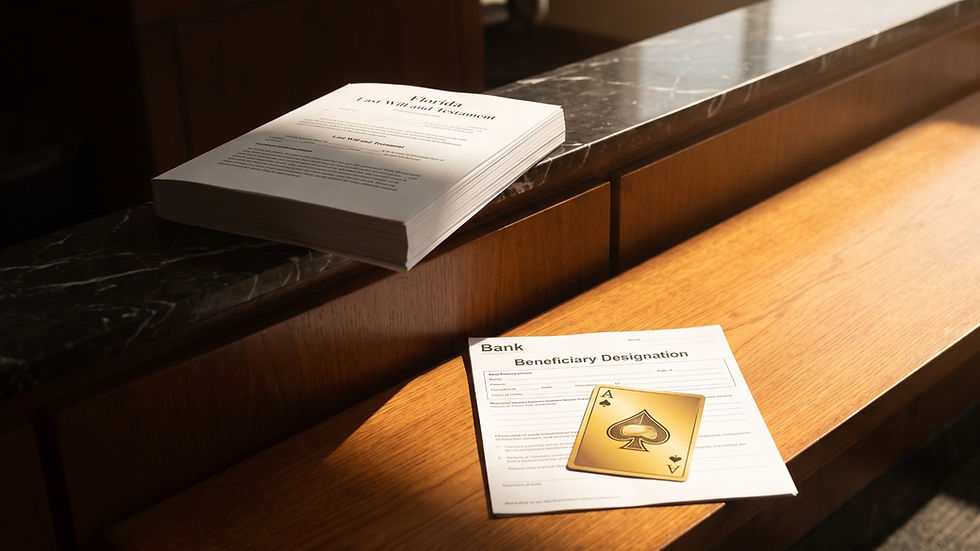
If you own anything, care about anyone, or have children at home, creating a Florida last will and testament is one of the most straightforward things you can do to protect your family. A well-crafted will puts the right legal structure around your wishes so your loved ones aren't left guessing or arguing in a Pinellas County courthouse when the time comes.
But what if you spend hours carefully planning your estate and wording your will, only for someone to play a "trump card" that completely overrides your wishes?
In estate planning, this happens more often than you might think. Here is what you need to know about how certain account designations can outrank your will, and how to make sure all your estate planning arrows point in the exact same direction.
What Your Florida Last Will and Testament Actually Does
A Last Will and Testament is a legally binding document that directs who receives your property, who manages your estate (your executor), and if you have minor children, who raises them, if something happens to you.
Under Florida Statute §732.502, the execution requirements are very specific: a valid will must be in writing, signed by you, and witnessed by two people who sign in each other's presence and your presence. A document that misses any of these strict requirements can be challenged or invalidated entirely.
However, the biggest mistake people make isn't just failing to meet these requirements—it's assuming that the will controls everything.
The Estate Planning "Trump Card": Beneficiary Designations
In card games, a "trump card" is a card that can outrank and outplay any other card it's played against, giving that player a winning advantage. In estate planning, a trump card occurs when a specific designation on an asset outweighs whatever you have written in your will.
Let's say you create a Florida last will and testament that divides your assets perfectly: a certain percentage to one child, a percentage to a friend, and a percentage to another child. You thought it through and you know exactly who you want to receive what.
However, on your actual bank or financial accounts, you listed specific "POD" (Pay on Death) beneficiaries. Does one outweigh the other?
Yes. Your beneficiary designations will outweigh what you write in your will.
If your POD designations don't align with the specific percentages in your will—sometimes because the bank only allows you to list one or two people—the will becomes essentially useless against them. What is stated in your will takes a backseat, and whoever is listed on those account forms will prevail. You can even put a beneficiary on your home using a Florida Lady Bird deed, and if that deed doesn't match your will exactly, the deed wins.
The Danger of Adding a Joint Owner
Another common way your will can be overridden is by adding a joint owner to your account. Often, a parent will add one child to a checking or savings account for convenience—just to have someone who can help pay bills or cover medical expenses.
You might think, "I put in my will that the account ultimately needs to be split between my three children, so it will be fine."
That is not how it works. If you have a joint owner on the account, 100% of that account goes to that joint owner. The will does not override that, and it cannot force that one child to split the money with their siblings.
Furthermore, adding a joint owner (other than a spouse) carries major risks while you are still alive:
Immediate Access: They can legally withdraw money at any time.
Creditor Risk: Because your asset is now legally their asset, it could be subject to the claims of their creditors or judgments against them.
Make Sure Your Arrows Point in the Same Direction
When you sit down to plan what should happen to your assets, it is critical that your entire plan aligns. Your Florida last will and testament, your POD designations, your joint accounts, and your property deeds must all point in the same direction.
If they don't match up, an unintended "trump card" is going to win out. If it's not the one you wanted to win, your plan for the future isn't going to go as intended.
Get Non-Stuffy Legal Help in Pinellas County
Estate planning doesn't have to be complicated, but it must be done correctly. At atCause Law Office, the "non-stuffy attorneys," we help families across Clearwater, Dunedin, Safety Harbor, and St. Petersburg get this done right. We offer simple processes, clear flat-fee pricing, and documents that actually hold up.
If your beneficiary designations can't work the way you want them to, we can help you look into creating a trust to keep your plan in your hands and out of the courts.
Don't leave your legacy up to a trump card. Call atCause Law Office today for a complimentary consultation at (727) 477-2255.


Comments