.png)


A Florida Homeowner’s Guide to Avoiding Probate via Property Deeds

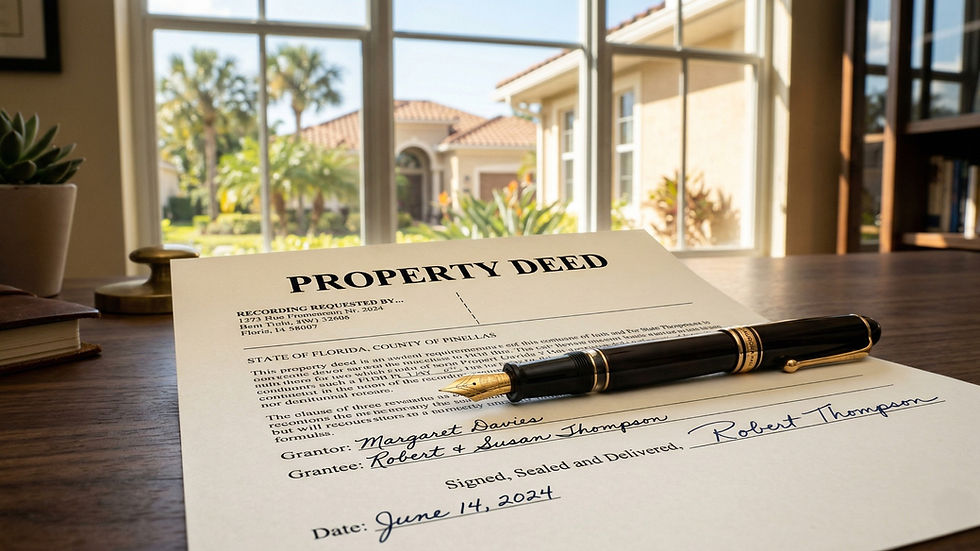
If you own property in Florida with a family member—like an aging parent or an adult child—you probably have a simple goal: if one of you passes away, the other should automatically inherit the home without the headache, delay, and expense of probate court.
Many Florida homeowners assume that simply having both names on the property deed is enough to make this happen. Unfortunately, this is a massive misconception that often isn't discovered until it's too late.
Let's look at why simply being on a deed doesn't guarantee a smooth transition, the "magic words" your deed actually needs, and how you can fix a deed that was filed incorrectly.
The Common Trap: Tenancy in Common vs. Joint Tenancy
In Florida real estate, how you hold the title is just as important as who is on the title. When two people are listed on a deed, the state typically categorizes the ownership in one of two ways:
Tenancy in Common: This is the default assumption in Florida if no specific legal language is used. It means each person owns a specific, undivided portion of the property (usually 50/50). If you own a home as a tenant in common and pass away, your 50% does not automatically go to the other person on the deed. Instead, your half must go through the Florida probate process to be distributed to your heirs at law or the beneficiaries named in your will.
Joint Tenancy with Rights of Survivorship: This is the type of ownership most families actually want. In this arrangement, both owners own the property as a whole. If one owner passes away, their interest instantly vanishes, and the surviving owner automatically owns 100% of the property. No probate, no court action, and no hassle.
The "Magic Words" You Need
If you look at your deed and it simply lists your name and your co-owner's name (e.g., "Jane Doe and John Doe"), Florida law assumes it is a Tenancy in Common.
To ensure the property bypasses probate and goes directly to the surviving co-owner, the deed must explicitly state your intentions. You need what legal professionals often call the "magic words" right after your names as the grantees:
"...as Joint Tenants with Rights of Survivorship" (or "...with full rights of survivorship").
If your current deed lacks those specific phrases, it is not a joint survivorship deed.
How to Fix an Incorrect Deed in Florida
If you just checked your deed and realized it’s set up as a Tenancy in Common, don't panic. Because you and your co-owner already own the property, changing the designation is a straightforward process. You generally have two options:
Request a Corrective Deed: If a professional (like a title company or an attorney) prepared your deed recently and made a clerical error by omitting your requested survivorship language, you can ask them to file a Corrective Deed to fix the mistake.
Execute a New Quitclaim Deed: If you simply didn't know about the required language when you filed, you and your co-owner can execute a new deed—most commonly a Quitclaim Deed. In this scenario, you are both the grantors (giving the property) and the grantees (receiving the property). You simply draft the new deed to transfer the property from yourselves to yourselves, this time explicitly adding the "Joint Tenants with Rights of Survivorship" language.
Taking It a Step Further: The Florida Lady bird Deed
Securing a Joint Tenancy protects the surviving owner, but what happens when the second owner passes away? At that point, the property would once again be headed straight for probate.
Florida is one of the few states that allows for a unique estate planning tool called an Enhanced Life Estate Deed, more commonly known as a Lady bird Deed.
Once you have established your Joint Tenancy, you and your co-owner can execute a Lady bird Deed to name specific beneficiaries (like other children, grandchildren, or a charity) who will automatically inherit the property after you both pass away. It adds an incredibly powerful layer of estate planning that keeps the home out of the court system entirely.
A Quick Note on Getting Help: While fixing a deed is relatively simple, real estate laws require precision. Because even a tiny clerical error can send your family's biggest asset to probate court, it is highly recommended to consult with a Florida estate planning attorney to draft and file your new deed correctly. Contact atCause law and schedule a free consultation with our team!


Comments