.png)


Why a Revocable Trust is Better for Your Florida Estate Plan

When planning for the future of your estate, ensuring a seamless transition for your loved ones is likely a top priority. A majority of adults in the United States have no documents in place for their end-of-life planning, which can leave families struggling to navigate the estate. While establishing a will is a great step, a trust provides an extra layer of protection and preparation.
If you are exploring your estate planning options in Florida, you have likely come across both revocable and irrevocable trusts. atCause Law Office, knows that keeping an estate planning simple, flexible, and fully aligned with your goals is paramount. Here is a breakdown of what a revocable trust is, how it functions, and why it is typically the better choice for your estate plan.
What is a Revocable Trust?
A revocable trust is frequently referred to as a "living trust." It earns this name because it is created while you are alive and well, distinguishing it from a testamentary trust, which is created within your will and only takes effect after you pass away.
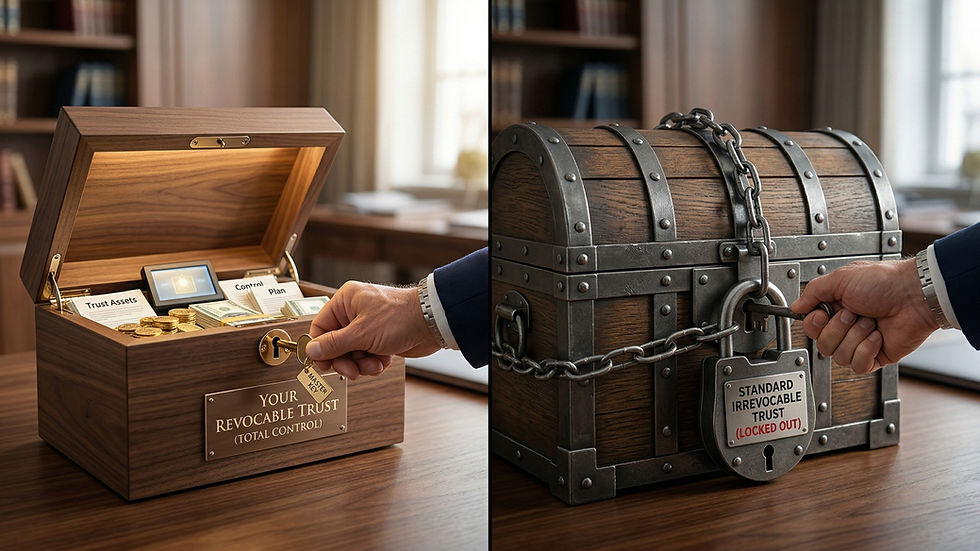
Under the eyes of the law, a revocable trust is essentially an extension of yourself. As the Grantor (or Settlor) who creates the trust, you maintain total ownership and control over the assets placed inside it. You also usually act as the initial Trustee, meaning you continue to manage your wealth and property exactly as you did before the trust was created.
Top Reasons Why a Revocable Trust is the Better Choice
For the vast majority of individuals, a revocable trust provides everything needed to establish a secure, private, and highly effective estate plan. Here is why a revocable trust is usually the superior choice:
1. Complete Control and Flexibility
Because a revocable trust is an extension of yourself, you are never locked into a permanent decision. As long as you are alive, you have the absolute power to:
Revoke or get rid of the trust entirely.
Change who the beneficiaries are.
Change who will serve as your Successor Trustee.
Update the rules for how and when assets are distributed.
2. Effortless Asset Management
Moving assets in and out of a revocable trust is simple. Selling a property or an asset that is owned by your revocable trust is exactly the same as selling it if it were owned in your own individual name. You don't have to jump through legal hoops to manage your everyday finances.
3. Immediate Probate Avoidance
One of the primary reasons people choose a living trust over a standard will (or a testamentary trust) is to avoid probate. When your assets are properly funded into a revocable trust, they bypass the lengthy, expensive, and public court process of probate. Upon your passing, your Successor Trustee can distribute your assets directly to your beneficiaries under the exact instructions you left behind.
Revocable vs. Irrevocable Trust: Is There Any Reason to Choose Irrevocable?
While a revocable trust is designed for flexibility, control, and probate avoidance, an irrevocable trust requires you to legally give up ownership and control of your assets. You cannot serve as the trustee of your own irrevocable trust, and making changes to the document is notoriously difficult—often requiring the agreement of all beneficiaries or even formal court approval.
Because of these strict limitations, irrevocable trusts are not necessary for most everyday estate plans.
However, there is one main reason why someone might choose to utilize an irrevocable trust over a revocable one: qualifying for government programs like Medicaid. By permanently transferring ownership of certain assets to an irrevocable trust, those assets are no longer counted as yours, which can help individuals meet the strict income and asset thresholds required for Medicaid long-term care benefits.
The Qualified Income Trust (QIT) / Miller Trust
If you or a loved one are trying to qualify for Medicaid to cover long-term care costs but have income that exceeds the strict Florida Medicaid limits, an irrevocable trust is required by law to bridge the gap.
This specific type of irrevocable trust is called a Qualified Income Trust (QIT), commonly known as a Miller Trust. By establishing a Miller Trust, excess income is funneled into the trust, legally removing it from your countable income. This allows individuals who would otherwise make "too much" money to successfully meet Medicaid's strict financial thresholds and get the care they need.
Secure Your Future with atCause Law Office
Estate planning doesn't have to be complicated, stuffy, or intimidating. If you are in Florida and want to protect what matters most to you while maintaining total control of your hard-earned assets, a revocable trust is an incredibly powerful tool.
If you have questions about trusts, elder law, probate, or general estate planning, let us make the process simple for you. Contact atCause Law Office in Clearwater, Florida to schedule your complimentary consultation!


Comments